What you actually need before you book a sprint
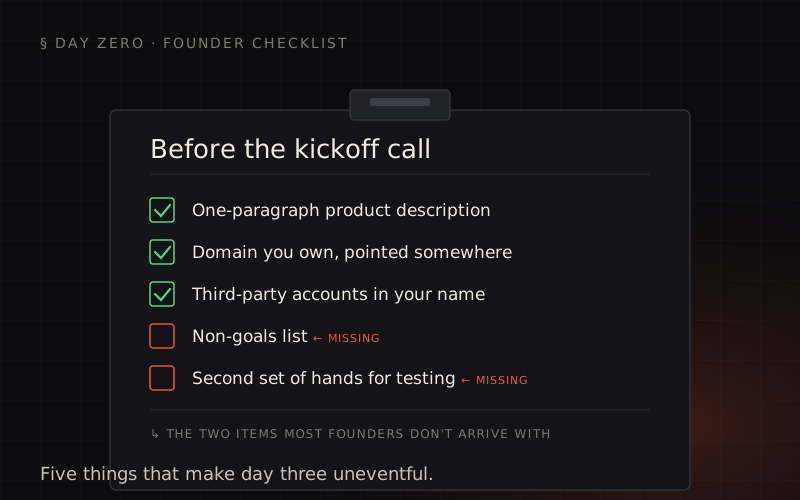
The five-item checklist we wish every founder had on day zero — and the two items most don't.
The discovery call is the place we answer most of the questions about scope, stack, and cost. It's a bad place to answer "what colour is the logo?" — not because the question is unimportant, but because a question like that sitting unanswered on day four is half a day of avoidable thrash.
Here's the short list of things we wish every founder had in place on day zero. Not all of them apply to every project, but most of them apply to most.
One: a one-paragraph product description
Not a pitch deck. Not a Figma file. A paragraph. If you can't explain the product in five sentences, we're going to spend the first discovery session trying to — which is fine, but it's time we could be spending on the spec instead.
A good version of this paragraph names the user, the problem, the thing the product does about it, and the one way you'll know it's working. Five sentences, maybe six. If it reads like a pitch, rewrite it like a description. We don't need to be sold; we need to be briefed.
Two: the domain, pointed at something
A domain you own. Pointed at anything — a holding page, a Carrd, whatever. Not a subdomain of your old consulting firm. Not something you'll "get on the day." Domains are the second-most-common source of last-minute drag in a sprint, usually because DNS changes take hours to propagate and the original registrar has 2FA on a phone you no longer use.
If you don't have a domain yet, buy it before the kickoff call. If you have one but can't log in, sort that out first. This one small thing removes a whole category of day-twelve stress.
Three: the third-party accounts the product depends on
Anything the MVP integrates with, created in accounts you own.
- Stripe (if you're taking payments) — real business details. Activation can take a day.
- Email provider — a Resend or equivalent account, attached to your domain, with DNS records added. DNS again, so same rule as above.
- Google Workspace — if the product uses Google OAuth, a workspace owner account you control.
- Anything else in the spec — CRM, scheduler, form provider, analytics.
We can set these up for you as part of the sprint. What we cannot do is accelerate the approval timelines that each provider owns. Stripe can take a day to activate a new account. Google can take longer to approve an OAuth consent screen. A sprint that lands on "feature-complete except payment activation is pending Stripe review" is a sprint that landed late, even though the engineering didn't.
Four: decisions on the two or three things you haven't decided
Every founder arrives with decisions they haven't yet made. That's fine — it's what discovery is for. But there are two or three decisions it's faster to make before kickoff than during it.
- Pricing. A plan, a number, a billing frequency. "Free for a bit and then we'll figure it out" is not a pricing decision; it's a deferral. Deferrals cost you a day in scope disagreement.
- Auth model. Open sign-up, invite-only, SSO, or a waitlist. Each changes the first real feature we build.
- Ownership. Is this your company, a subsidiary, a new entity? Who gets the GitHub org? Whose name is on the Stripe account? It's easier to make these decisions before there's a codebase attached to them.
If you're genuinely undecided on any of these, we'll help you decide in discovery. But coming in with an answer — even a rough one — saves half a day.
Five: someone to answer questions the same day
Not you specifically, if that's not realistic, but someone. We run a daily check-in and send a daily Loom, and we need a founder-side response before we start the next day's work. If questions sit in an inbox for two days, the sprint's day count quietly changes to five.
The two founders for whom our sprints land most reliably are the ones who treat the sprint as the most important week on their calendar. Twenty minutes a day, reliably. Not more. That's enough. What doesn't work is two untouched days followed by a long message pack on day five.
The two items most founders don't have
If you only take two things from this post, these are the two that matter most — and the two that most founders don't arrive with.
A clear non-goals list. The things you are not building in this sprint. A non-goals list is a scope protection device. If you can't tell us what's out, nothing is in.
A second set of hands available for testing. You are a bad tester of your own product; you know it too well. Line up one or two people who'll click through the staging link on day four. Not ship-quality feedback — just second-pair-of-eyes feedback. This catches more issues than anything we do ourselves.
What you don't need to have
Some things founders worry about that they shouldn't.
- Final copy. We'll write a first pass. You'll edit it. That's the right order.
- Design system. We have a default we extend to your brand. Unless you come in with a senior designer, starting from scratch is slower.
- A roadmap. One MVP, well-scoped. Roadmaps are what sprint two is for.
- Deep technical opinions. It's fine if you have them, but we'd rather solve the product problem than re-litigate framework choices.
The short version
Domain you control, third-party accounts you own, a paragraph of product description, a couple of decisions, and someone to answer questions within the day. That's the kit. Everything else we can work out with you during discovery.
If you've got those five things, book the sprint with confidence. If you haven't, the discovery sprint is the place to get them. Either way, showing up prepared makes day seven a smaller event, not a bigger one.